


Update 10/2/26: Al Suhu, CEC26 President, sent me the official rerponses to their excellent reso on the dysfunctional SCA governance system and board. The reply from DOE Deputy Chancellor Kevin Moran, who now runs the SCA board as the Chancellor’s representative, was pretty good; the response from Andrea Bender, formerly the SCA VP of External Affairs was typically rude and dismissive. Glad that she has been removed from that position at the last board meeting, as described below.
Sue Edelman has now reported on a much-needed housecleaning happening at the NYC School Construction Authority, after years of mismanagement and corruption, as it now appears. There is no government agency more distrusted by NYC parents and less accountable than the SCA, which despite billions of dollars of city and state funding has refused to be transparent or do its job with any reliability, leading to huge delays in addressing critical safety and repair issues, and no plans to provide sufficient space to comply with the class size law passed more than four years ago. More on this below.
These problems have been enabled by serious failures in governance. For nearly two years the SCA board had only two members — in violation of the law that established the agency that required three board members at all times, as Sue Edelman previously wrote about here. After her article appeared in the NY Post in August 2024, I wrote about this serious failing and spoke up about it at a SCA board meeting on March 20, 2025, criticizing this and other governance problems, including their lack of a whistleblower policy.
At that meeting, Deputy Chancellor Dan Weisberg, who led the board as Chancellor Ramos’ representative, was rudely dismissive. Yet only two weeks later, a third board member was finally appointed: Liz Bergin, a former high-level employee of the SCA. While then-General Counsel Nadine Rivellese disputed the lack of a whistleblower policy, in contradiction to the findings of a report from the NY State Authorities Budget Office, the SCA board finally approved a Whistleblower policy at their May 15, 2025 meeting,
I attended a subsequent SCA board meeting on November 20, 2025, and explained there were still serious deficiencies in SCA’s accountability, including their failure to comply with state and city laws requiring them to report where schools are needed and where they will be built, and how sufficient space for smaller classes will be provided, as mandated by the class size law passed by the state in June 2022. My account of that meeting and the letter I read aloud to the Board is here.
Last week on Sept. 24, 2026, I attended another SCA board meeting, led by a new Board, with the Chancellor Samuels’ representative, Kevin Moran, who ran the meeting along with the new SCA President, Celeste Ramirez, appointed by Mayor Mamdani on June 12, in place of former SCA President Nina Kubota.
It didn’t start well. Unlike previous meetings I had attended at the DOE headquarters on Chambers Street in lower Manhattan, this one was held at an office building in Long Island City, where the SCA is now headquartered. Several parent leaders and I were forced to wait in the lobby downstairs for 15 to 20 minutes while the person at the desk attempted to reach SCA officials by phone, so they could approve our names and allow us to attend the meeting upstairs. Yet under the New York State Open Meetings Law, public bodies like the SCA may collect names or require sign-ins at the door for security or capacity reasons, but they cannot require that those walking in obtain permission to attend from the relevant government agency.
When we finally were able to take the elevator and join the meeting, the atmosphere was quite different from SCA meetings I’d attended previously. Instead of suspicious looks from the board members and SCA officers, the new President, Celeste Ramirez, was warm and welcoming. DOE Chancellor Samuels’ representative, Kevin Moran, the long-time head of the Division of School Facilities and now the Deputy Chancellor for School Operations was there, along with a new Mayoral appointee to the board, Minelly De Coo, a Port Authority executive. More on her background and that of In Cho, the third new member of the board, is here.
When the meeting began, the Board secretary Jessica Reyes emphasized that despite In Cho’s absence, two members were present so they did have quorum. She also stated that there were indeed three appointed members (as legally required.). Kevin Moran gave a nod to the SCA’s efforts to provide space for class size reduction (still insufficient as I explain below) and saluted the opening of several new school buildings this fall.
President Celeste Ramirez welcomed the assorted parents sitting in the audience, and said that she will work with and be accountable to them. She said she could not speak to the problems of the past, but that she would do her best from now on in terms of outreach and communication.
The Board proceeded to approve the minutes of the August meeting (which I didn’t attend), and then voted for the renewal of several multi-million dollar consulting contracts, though not for MWBE consultants, which Ms. Ramirez said had not been effective. They then voted to remove the previous General Counsel, Nadine Rivellese, (who had already been removed as head of Human Resources on August 20 and escorted out of the building on August 31). Ms. Ramirez announced the appointment of a new interim General Counsel, Scott Bridge, who had served previously under Rivellese.
They also voted to remove the former VP of External Affairs, Andrea Bender. Ms. Ramirez explained that from now on, this office would now be divided between a new Community Engagement Unit (led by Yvette Knight) and a Communications and Media Relations Unit (led by Kevin Ortiz).
Then the public comment period began. I spoke first and read aloud a letter which I had earlier emailed to Ms. Ramirez, Kevin Moran, and the Chancellor. I also handed physical copies to Moran and Minelly De Coo before starting. (This letter along with footnotes and citations is also posted here.)
Dear President Ramirez
I am extremely happy that the School Construction Authority has new leadership that will hopefully lead to the agency being more responsive, transparent and accountable in the future.
At a SCA board meeting on March 20, 2025, during the public comment period, I pointed out that the board had lacked the necessary three members required by law for nearly two years. Three members are required at all times by the state law that established the SCA in 1988, but after Lorraine Grillo resigned from the board in August 2023, no replacement was appointed. At that meeting, I also pointed out that the SCA lacked a whistleblower policy, along with many other legally required policies, according to the 2025 report of the NY State Authorities Budget Office.
Though Deputy Chancellor Dan Weisberg, the Chancellor’s representative at that time, dismissed my concerns, a third member to the board was appointed two weeks later, Liz Bergin. Then, less than two months after that, the SCA board approved a Whistleblower policy at their May 15 meeting.
However, according to the most recent report from the NY State Authorities Budget Office, the SCA still lacks a Governance Committee, a Finance Committee, and policies for Salary and Compensation, as well as Time and Attendance, though all these bodies and policies are required by the New York Public Authorities Law.
I am even more concerned with the fact that the SCA has up to now failed to comply with its responsibilities related to the class size law.
While Cora Liu of the SCA testified to the City Council in March 2025 that 70,000 school seats would be needed to comply with the class size law, fewer than half of those seats --33,417 – have been funded in the latest iteration of 2025-2029 Capital Plan. Only 17,415 new seats were projected to be completed by September 2029, the new extended deadline in the class size law. Moreover, 13,000 of those seats, or 39%, were unspecified as to district/subdistrict/ or grade level.
This lack of transparency appears to violate two laws.
· First, the state class size law itself requires DOE to submit an “annual capital plan for school construction and leasing to show how many classrooms will be added in each year and in which schools and districts to achieve the class size targets.”
· Second, it also violates Local Law 167, passed by the Council in 2018, requiring the SCA to explain where seats are needed by district, subdistrict and grade level, as well as the demographic data and methodology used to make these projections.
Yet instead of becoming more transparent after this Local Law 167 was passed, the capital plan became even more opaque, by eliminating the column listing the number of seats needed from the plan.
In the most recently adopted city budget, Mayor Mamdani added $1.5B to the school capital plan, but I am concerned that this still may be insufficient, as it would fund only about 8,000 more seats, based on the current per seat cost. DOE informed the City Council that the 4,656 additional school seats that came online in Sept. 2025 had increased class size compliance rates by only 1.2 percentage points. If the same ratio holds, an additional 8,300 seats would improve compliance by a little more than 2 points.
According to the latest iteration of the annual DOE Class Size plan posted on Sept. 8, there are 483 unnamed schools with insufficient space to lower class size, though the document provides no actual discernible strategies to provide any of these schools with the space they need to lower class size to mandated levels at any time certain.
As there are thousands of empty seats in underutilized schools sitting close to overcrowded schools, aligning the DOE enrollment policies with the class size goals would allow many more schools to comply more quickly and would save billions of dollars in the process. This strategy could also help support underenrolled schools. which now struggle with inadequate budgets. Yet DOE has not committed to doing this either.
Examples: For 135 unnamed, overcrowded schools that have “significant space needs” and need more space built nearby, they say “SCA will work to identify viable solutions for these schools in accordance with available funding” (emphasis mine) . For the 45 unnamed schools needing only slight shifts in enrollment, it says, “These schools will be considered for such enrollment adjustments by District Planning, Student Enrollment and Superintendents and their teams.”
In April 2023, then-Chancellor Banks appointed a Class Size Working Group to recommend new policies to help the city implement the law. I sat on this Working Group that released a comprehensive final report in December 2023. Sadly, nearly three years later, few if any of our recommendations to create more space more quickly and affordably have been adopted.
In the past, even when new schools were funded to relieve overcrowding in certain neighborhoods, too often these funds remained unspent, as SCA officials said they could not find suitable sites for schools. This contributed to a cumulative shortfall of about $4.6 billion over 15 years of spending on new capacity compared to the amount funded in the last three approved capital plans.
The School Siting Task Force, designed to address this issue, was created by Local Law 168 in 2018, tasked with reviewing city-owned properties and vacant land, both privately and publicly owned, to identify opportunities for new school construction or leasing . This task force met only once in February 2019 and again in July 2019. It solicited no input from the community or its City Council or parent members. I obtained their two-page report via FOIL in 2020, along with a spreadsheet that that excluded hundreds of publicly owned lots for unclear reasons and never analyzed more than 22,000 privately owned lots.
To address this issue, our Working Group recommended that the Task Force be restarted and analyze all city-owned and privately owned empty lots, as well as city-owned buildings for their appropriateness for schools, this time with community involvement.
Other recommendations from the Working Group that have been ignored include reviving the Educational Construction Fund, created in 1967 to create new schools in mixed development projects. Only 15 schools have been built via ECF since that time, the last one over a decade ago, in 2012. The Group also recommended that schools should be incorporated in the planning process for affordable housing projects, where they can serve as “anchor tenants” to help with financing. New high rises are being built in many neighborhoods where the schools are already overcrowded and likely to become more so in the future, without decided action now.
Instead of adopting any of these positive and practical proposals to speed up school siting and construction, DOE’s latest iteration of the class size plan says the following:
“City is currently engaging with elected officials at the State level on a proposed SEQRA reform that would carve out public school construction projects from environmental review.”
It is unclear if this troubling proposal is in addition to a new provision in the state budget exempting new NYC schools from environmental review – which is problematic enough. The answer to providing NYC students with the classroom space and smaller classes to which they are entitled is not to expose them to potential environmental harm.
I would be happy to meet with you and/or your team to discuss these matters in more detail, if that might help you with your challenging work moving forward. Please let me know.
Please also forward this message to Ms. De Coo, as I could not find her email address.
I was glad to see Kevin Moran take notes while I was speaking. After I was done, President Ramirez assured me that she prizes full transparency and that she would provide a detailed response to my points soon. I asked her whether the new version of the School Capital Plan due in November would provide the transparency required, and she said she would look into it.
After I spoke, CEC members and other parent leaders stood up and described long-standing problems including failures in communication, unacceptable delays in finishing projects despite funding allocated years before, and DSF and SCA officials blaming each other about who was responsible for completing these projects. Kevin Moran and Ms. Ramirez admitted that while all these issues had been too-common in the past, they were now intent on fixing them, In particular, they said, blame shifting between SCA and DSF would end.
Al Suhu, CEC 26 President, stood up to speak and pointed out though District 26 was one of the most overcrowded districts with some of the highest class sizes, there are only two new projects funded for his district. He also spoke of a resolution passed by the CEC that argued that one of the primary causes of overall SCA dysfunction was the failure of the Board up to now to understand their responsibilities. He said that most boards require that specific performance goals be presented and progress towards those goals regularly reported to the Board but that never happens. Instead, these board meetings have been cursory and short. President Ramirez promised that she had already started devising these metrics and would be reporting on the progress made at future meetings.
Jill Rackmill of CEC 3 referenced a CEC report on the lack of transparency of SCA officials, and their refusal to attend their meetings and share information. One of the issues she mentioned was how difficult it is to track the progress of specific, funded projects in their schools, as the data was only available through dense PDFs, difficult to follow. President Ramirez promised that this data was being converted into excel files that would be easier to read and sort.
Adriana Aviles, Queens rep on the Citywide Council on High Schools, spoke about how poorly the SCA had communicated problems to parents at specific schools when they arose, and that accessibility issues for disabled students too often go unaddressed. Sometimes these could be solved as simply as the installation of a wheelchair ramp, yet this could take many months to get this done.. Madeline Hernandez, the president of Queens HS President Council, introduced herself and asked for President Councils to be notified about SCA board meetings as well as CECs.
Wanda Balines, a member of CEC 8 in the Bronx, spoke about years of delay in completing projects, providing the example of a school library renovation that was funded in 2009, and was only finished this fall. She referenced projects in 42 schools in her district, many of them funded through City Council Reso A grants, in various stages of construction. She asked that Ms. Ramirez attend their December meeting, to present a clear timeline of when these projects would be done, and Ms. Ramirez agreed to attend and provide that list to the CEC.
Another Bronx parent whose name I didn’t catch reported on the need for more D75 programs and suggested one be sited in an underutilized school, to allow disabled students who live nearby to attend classes nearer to their home. Kevin Moran said he would look into this matter.
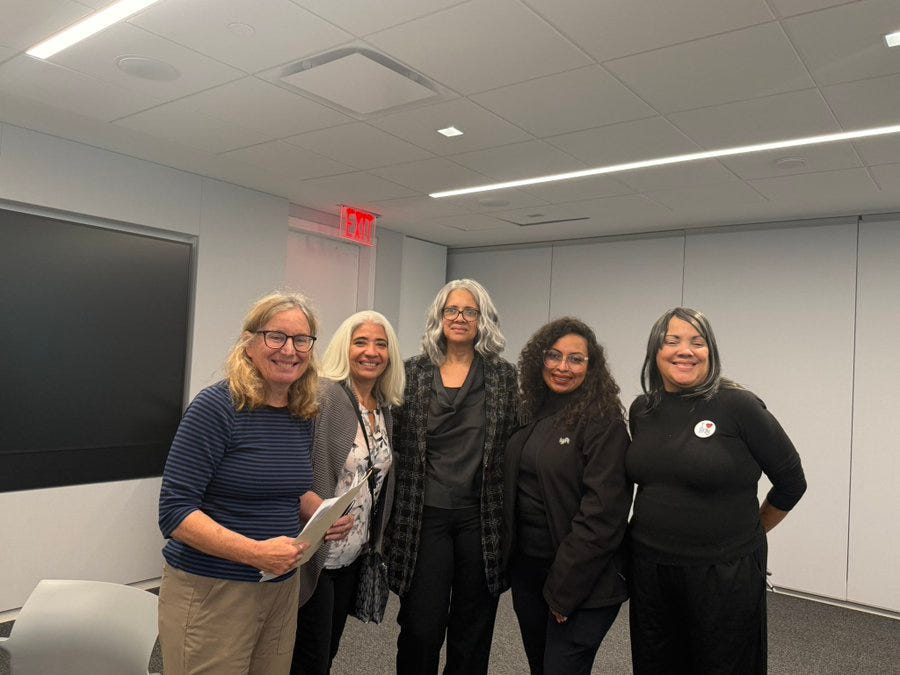
After the meeting concluded, Adriana Aviles asked for a photo to be taken of us with Celeste Ramirez, along with Madeline Hernandez and Wanda Balines, the CEC8 member. This photo is below.
Here’s hoping for a more accountable and transparent SCA. In my view, the evident change in attitude and promises made by this new SCA leadership are the only significant operational improvements that Mayor Mamdani has made so far related to education in our schools, compared to the dysfunction common during previous administrations. Only time will tell how meaningful it will be.
Have someone else start your car .. the corruption is deep with serious dudes,
?